
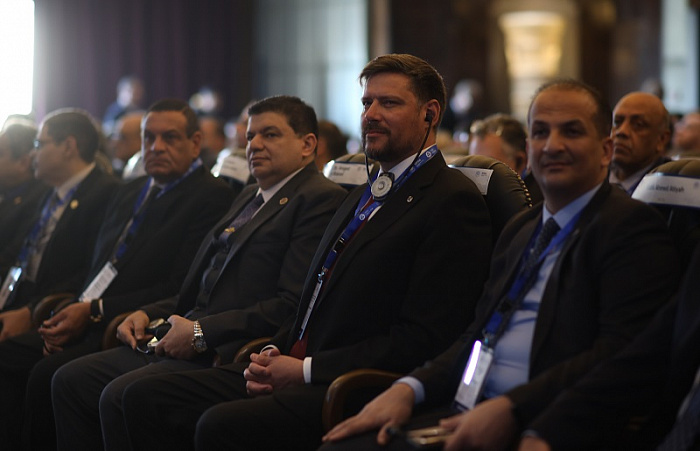
The fifth forum on the nuclear industry development in Egypt that is annually organized by the Rosatom State Corporation Engineering Division and the Nuclear Power Plants Authority (NPPA) of Egypt, was held in Cairo (Egypt) on December 2, 2023. The event is held as part of the Nuclear power week of the Arab Republic of Egypt
The forum was attended by Dr. Amged El-Wakeel, Board Chairman of NPPA; Eng. Mohamed Ramadan, Vice-Chairman of NPPA; Alexey Kononenko, ASE JSC Vice-President - Director for El-Dabaa NPP construction Project; Dr. Mohammed Dwiddar, El-Dabaa NPP Project Manager on behalf of NPPA.
When greeting the audience, Dr. Amgel El-Wakeel noted that the authorities of Egypt are interested in expanding the local community's participation in the Egypt full-scale national project. "The main forum objective is to provide Egyptian companies with an opportunity to join the El Dabaa Nuclear Power Plant project by clarifying the general contractor's main requirements that local companies have to comply with, in order to qualify for participation in the project. NPPA aims to strengthen cooperation between Egyptian and international companies specializing in the nuclear industry in order to improve the competence of Egyptian contractors," he said.
Aleksey Kononenko thanked the event participants for their interest in the nuclear industry and the development of nuclear technologies in Egypt.
"El Dabaa NPP is one of the largest nuclear construction projects. It will meet Egypt's growing electricity needs and ensure its energy safety. And we are pleased that more and more local companies are getting involved in the project to build the first NPP on the continent with Russian generation III+ technology, which will allow Egypt to become a regional technological leader," he noted.
During the forum, the participants discussed the El Dabaa NPP construction process, the Rosatom procurement system and the specific character of procurement activities as part of the project, the process of localizing production for the NPP needs and attracting local companies.
In particular, suppliers were interested in the prospects of nuclear technologies in Egypt, the development of the El Dabaa NPP infrastructure, the work of the joint committee on the project localization, the application of Russian and international standards in the manufacture of equipment.
Separate sessions of the workshop were devoted to issues of participation in the consortium with the Korean KHNP and the role of the El Dabaa NPP project in achieving the Sustainable Development Goals.
The event is attended by approximately 180 persons representing over 50 companies from Russia, Egypt, the Saudi Arabia, South Korea and France.
For reference:
El-Dabaa NPP is the first nuclear power plant in Egypt which will be built in the city of El-Dabaa, Matrouh province, on the Mediterranean coast, approximately 300 km North-West of Cairo. The NPP will consist of four power units, 1200 MW each, with generation III+ VVER-1200 reactors (pressurized water reactors). This is the newest generation technology which has references and is already operating successfully. There are four operational power units of this generation: two reactors at Novovoronezh NPP and two at Leningrad NPP. Outside Russia, one power unit of Belarus NPP with VVER-1200 reactor was connected to the grid in November 2020.
The NPP is being constructed in accordance with the package of contracts which entered into force on December 11, 2017. In accordance with the contractual obligations, the Russian party will not only construct the power plant but will also supply nuclear fuel for the whole life cycle of the NPP and will provide assistance to the Egyptian partners in training of the personnel and support of operation and service of the plant during the first 10 years of its operation. Under a separate agreement, the Russian party will build a special storage and will supply containers for storing spent nuclear fuel.