
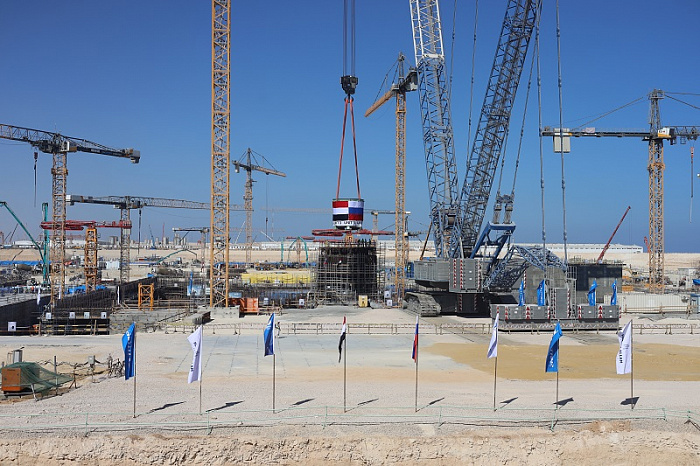
On October 6, 2024, works on installation of the core catcher body commenced at Unit 3 of El-Dabaa NPP in the Arab Republic of Egypt (the General Designer and General Contractor is Rosatom State Corporation Engineering Division).
The core catcher is long-lead equipment; it consists of several elements with the total weight of 480 tons, while the core catcher body weighs 155 tons. The installation was performed by a team of 10 persons, using a heavy-wight crane Zoomlion ZCC 32000 with the lifting capacity of 2000 tons.
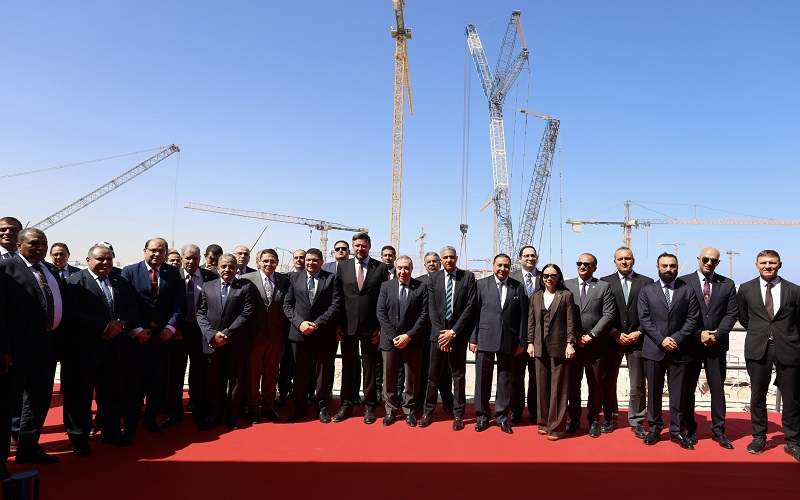
The official ceremony dedicated to the commencement of the core catcher installation was attended by Dr. Amged El-Wakeel, Board Chairman of Nuclear Power Plants Authority of Egypt, Alexey Kononenko, ASE JSC Vice President - Director of El-Dabaa NPP Construction Project.
“Today, we are glad to note the completion of another milestone for this year. Works on the core catcher installation at Unit 3 started in accordance with the schedule. It would be impossible without comprehensive cooperation of the Egyptian Owner and the General Contractor. I would like to express profound gratitude to everyone who put their efforts in the achievement of this production stage in our project. We are looking into the future with confidence and going on with the construction of the safest and most up-to-date NPP in the world!”, noted Alexey Kononenko, ASE JSC Vice President - Director of El-Dabaa NPP Construction Project.
Dr. Amged El-Wakeel, Board Chairman of the Nuclear Power Plants Authority of Egypt, stated that “Egypt prioritises nuclear security and safety. The core catcher is one of the main elements in the safety systems of the El-Dabaa nuclear power plant, reflecting the highest levels of nuclear safety to ensure the safe and continuous operation of the plant. It is a unique safety system, installed under the reactor vessel's base, to enhance the safety of the nuclear power plant. Dr. El-Wakeel further pointed out the successful achievement of key milestones for the El-Dabaa project, in an unprecedented time would not have been possible without the continuous support of His Excellency President Abdel Fattah El-Sisi, the beacon of hope and leader of the development journey in our country, and the ongoing support of all national authorities. Dr. El-Wakeel also emphasised that what is currently happening at the El-Dabaa nuclear power plant site is not a product of chance but rather the result of hard, diligent work from both the Egyptian and Russian sides, who worked tirelessly to achieve all the main project milestones according to the agreed timelines.”
The cargo with components of the core catcher was delivered to the sea port of El-Dabaa construction site on July 1, 2024. The vessel that departed from the port of Novorossiysk arrived in Egypt in six days.
Information about El-Dabaa NPP project:
El-Dabaa NPP is the first NPP in Egypt. It is being built in the city of El-Dabaa, in the Matrouh province on the Mediterranean coast, approximately 300 km north-west from Cairo. The NPP will consist of four power units, 1200 MW each, with pressurized water reactors of Russian class VVER-1200. This is an evolutionary Gen III+ design which fully complies with all international safety requirements.
Rosatom has passed over from single unique projects to serial conveyor production. Four nuclear power units of this generation are in operation: two reactors of Novovoronezh NPP and two reactors of Leningrad NPP, two power units of Belarus NPP outside Russia. Construction of nuclear power plants under Russian technology is underway in Bangladesh, Hungary, Turkey and China.
El-Dabaa NPP is being constructed in accordance with the package of contracts, which entered into force on December 11, 2017. In accordance with the contractual obligations, the Russian party will not only construct the NPP but will also supply nuclear fuel for the whole life cycle of the NPP and will provide assistance to the Egyptian partners in training of the personnel at the operation and maintenance stages during the first ten years of NPP operation. Besides, under a separate agreement, the Russian party will build special storages and will supply special containers for storing spent nuclear fuel.
Communications Division
Rosatom State Corporation Engineering Division