
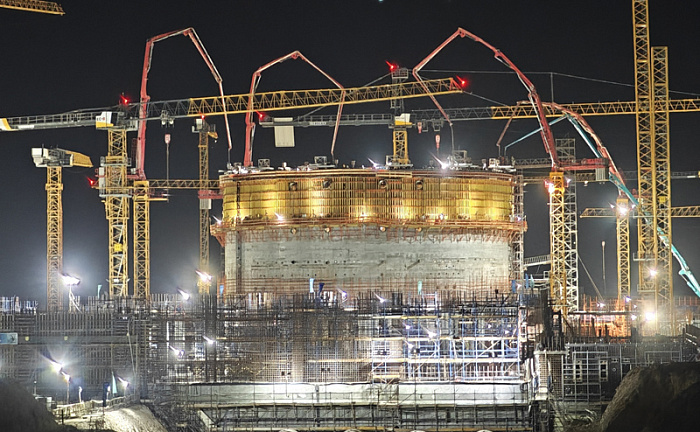
On Monday, May 19th, 2025, a new milestone was achieved in the implementation of El-Dabaa NPP project. The works on concreting for the second level of the second tier of the inner containment of the Reactor Building at Unit 2 has been successfully completed.
The works were completed ahead of the scheduled timeline, by the grace and guidance of God, and due to the dedicated and continuous efforts—day and night—of the specialists from Nuclear Power Plants Authority (NPPA) and the Russian general contractor, “Atomstroyexport”.
The inner containment is a cylindrical structure, inside which the nuclear reactor and the equipment of the NPP primary circuit will be located. The second tier of the internal containment consists of 12 segments, which were manufactured at the production facility of the construction site in Egypt. Each segment is 12 meters long and 14 m high, its weight varies from 60 to 90 tons.
The concreting process took 24 hours, with 4 concrete placement booms and about 65 people involved in the work. More than 1,000 cubic meters of concrete were laid in the reactor building.
Dr. Eng. Sherif Helmy, the Board Chairman of Nuclear Power Plants Authority, stated: "El-Dabaa NPP project is progressing steadily and confidently in accordance with the approved time schedules, reflecting the accuracy of planning and the efficiency of implementation across all phases of the project. Today, Nuclear Power Plants Authority witnessed a new achievement in the ongoing progress of the El-Dabaa Nuclear Power Plant construction project. This achievement demonstrates a new step forward in the implementation of Egypt’s peaceful nuclear program. It reflects a strong commitment to international technical standards, affirms the competence of national cadres, and highlights the fruitful partnership with the Russian party represented by Atomstroyexport. This progress is not just an engineering achievement, but a living testament to strong will, strategic planning, and well-coordinated teamwork. It stands as a foundational pillar in building a sustainable future based on energy diversification and enhancing energy security."
“Today, we achieved a significant milestone ahead of schedule due to the close cooperation between the Egyptian and Russian parties, high competence and qualification of the specialists involved in the work at this facility, and the use of the latest methods and technologies. We have reached new heights - the second tier of the inner containment rose to el. +20.150, the planned goal by the end of this year is the third tier at el. +29.150. We continue our confident and paced work on the construction of the safest NPP”, - said Alexey Kononenko, Vice President of Atomstroyexport JSC, Director of the El-Dabaa NPP construction project.
Information on El-Dabaa NPP project
El-Dabaa NPP is the first NPP in Egypt. It is being built in the city of El-Dabaa, in the Matruh province on the Mediterranean coast, approximately 300 km. north-west from Cairo. The El-Dabaa NPP consists of four 1200 MW power units equipped with Russian VVER-1200 pressurized water reactors of the latest third generation; these reactors are state-of-the art technologies that have been successfully operated at reference NPPs. Four nuclear power units of this generation are in operation: two reactors of Novovoronezh NPP and two reactors of Leningrad NPP, two power units of Belarus NPP outside Russia.
El-Dabaa NPP is being constructed in accordance with the package of contracts, which entered into force on December 11, 2017. The Russian side will not only build the nuclear power plant, but also supply nuclear fuel throughout the entire El-Dabaa NPP operating life in accordance with its contractual obligations. The Russian party is expected as well to assist Egyptian partners in training NPP operating personnel at the stage of operation and maintenance during the first ten years of the NPP operation. Besides, under a separate agreement, the Russian party will build special storages and will supply special containers for storing spent nuclear fuel.